
The Grandeur of St. Peter’s Basilica
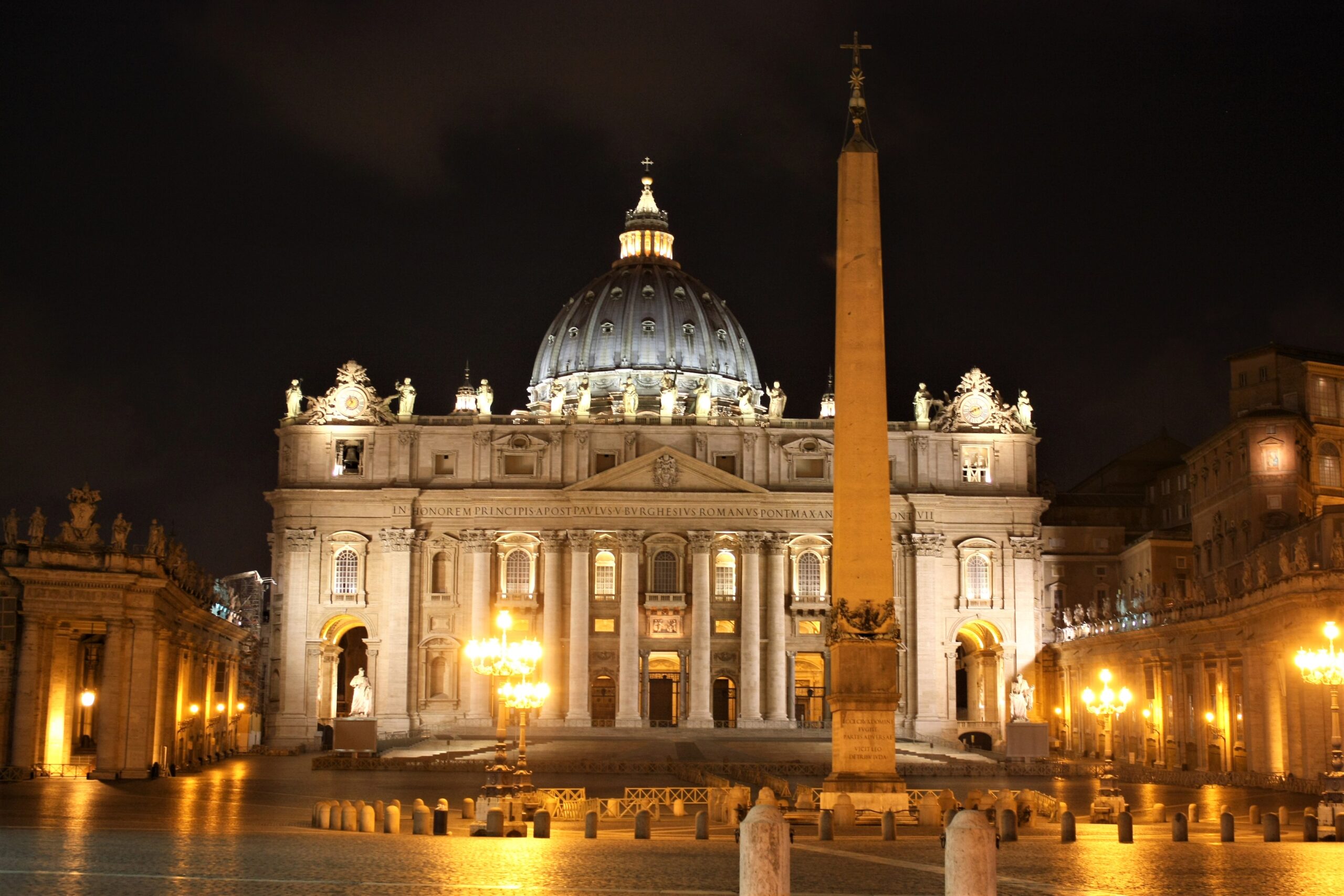
St. Peter’s Basilica, located in Vatican City, stands as one of the most iconic and awe-inspiring structures in the world. Its immense size, architectural splendor, and profound religious significance make it a focal point for pilgrims, tourists, and art enthusiasts alike. This magnificent edifice, often considered the heart of Catholicism, embodies centuries of religious devotion, artistic achievement, and historical transformation. In this exploration of St. Peter’s Basilica, we will delve into its history, architecture, art, and its enduring impact on both the faithful and the world at large.
Historical Context
The origins of St. Peter’s Basilica are deeply intertwined with the history of early Christianity and the Roman Empire. The site where the basilica stands today is traditionally believed to be the burial place of St. Peter, one of Jesus Christ’s twelve apostles and the first Bishop of Rome. St. Peter was martyred in Rome around 64 AD, during the reign of Emperor Nero, and was buried in a simple grave on Vatican Hill.
In the early 4th century, Emperor Constantine the Great, the first Roman emperor to convert to Christianity, ordered the construction of a basilica over St. Peter’s tomb. This original basilica, known as Old St. Peter’s, was completed around 349 AD. It served as the central place of worship and pilgrimage for Christians for over a millennium. However, by the 15th century, the old basilica had fallen into disrepair, prompting plans for a new, grander structure.
The Construction of the New Basilica
The construction of the new St. Peter’s Basilica began in 1506 under the direction of Pope Julius II. The ambitious project would take over 120 years to complete, involving some of the greatest artists and architects of the Renaissance and Baroque periods. Donato Bramante was the original architect, and he envisioned a grand central-plan structure with a large dome. However, Bramante’s death in 1514 led to a series of changes in the design and leadership of the project.
Several renowned architects, including Raphael, Antonio da Sangallo the Younger, and Michelangelo, contributed to the basilica’s design. Michelangelo, who took over the project in 1547, is particularly credited with refining and completing the dome, which remains one of the most recognizable features of the basilica. The dome, inspired by the Pantheon in Rome, symbolizes the heavens and is a masterpiece of engineering and artistry.
The basilica was consecrated on November 18, 1626, by Pope Urban VIII. The completion of St. Peter’s Basilica marked a significant moment in the history of the Catholic Church, symbolizing its spiritual and temporal power.
Architectural Marvel
St. Peter’s Basilica is an architectural marvel that exemplifies the grandeur and innovation of Renaissance and Baroque architecture. Covering an area of approximately 5.7 acres, it is one of the largest churches in the world, capable of accommodating over 60,000 people. The basilica’s design features a harmonious blend of classical elements, innovative engineering, and intricate details that create a sense of awe and reverence.
The Facade and Piazza
The basilica’s facade, designed by Carlo Maderno, is an imposing structure measuring 376 feet wide and 149 feet high. It features a series of Corinthian columns and pilasters, along with statues of Christ, the Apostles, and various saints. The grand entrance is reached via a monumental staircase, leading visitors into the awe-inspiring interior.
In front of the basilica lies St. Peter’s Square (Piazza San Pietro), a vast open space designed by Gian Lorenzo Bernini. The square is framed by two semicircular colonnades, symbolizing the embracing arms of the church. At the center stands an ancient Egyptian obelisk, flanked by two fountains. The square can accommodate hundreds of thousands of people, making it the perfect setting for papal ceremonies and gatherings.
The Dome
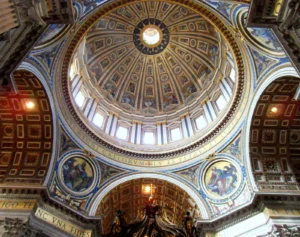
The dome of St. Peter’s Basilica, designed by Michelangelo and completed by Giacomo della Porta and Domenico Fontana, is one of the most remarkable features of the structure. Rising to a height of 448 feet, it dominates the skyline of Rome and serves as a symbol of the city’s religious significance. The interior of the dome is adorned with mosaics depicting scenes from the Bible, creating a celestial atmosphere.
Visitors can climb to the top of the dome, either by stairs or elevator, to enjoy breathtaking views of Vatican City, Rome, and the surrounding countryside. The ascent offers a close-up view of the intricate mosaics and the architectural genius of the dome’s construction.
The Interior
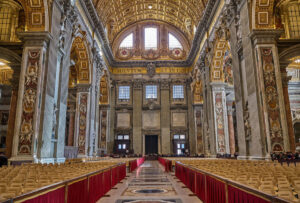
The interior of St. Peter’s Basilica is a testament to the artistic and architectural achievements of the Renaissance and Baroque periods. The vast nave, measuring 613 feet in length, is lined with massive marble columns and adorned with numerous chapels, altars, and sculptures.
One of the most striking features of the basilica is the baldachin (baldacchino) designed by Bernini. This monumental bronze canopy, standing over the high altar and the tomb of St. Peter, is supported by four twisted columns and is richly decorated with ornate details. The high altar itself is reserved exclusively for the


Nemo enim ipsam voluptatem quia voluptas sit aspernatur aut odit aut fugit, sed quia consequuntur magni dolores eos qui ratione voluptatem sequi nesciunt.